The Enhanced Games Aren't About Sports
The Enhanced Games launch today in Las Vegas with PEDs welcome. But the real story is the $1.2 billion peptide business Peter Thiel is building around it.

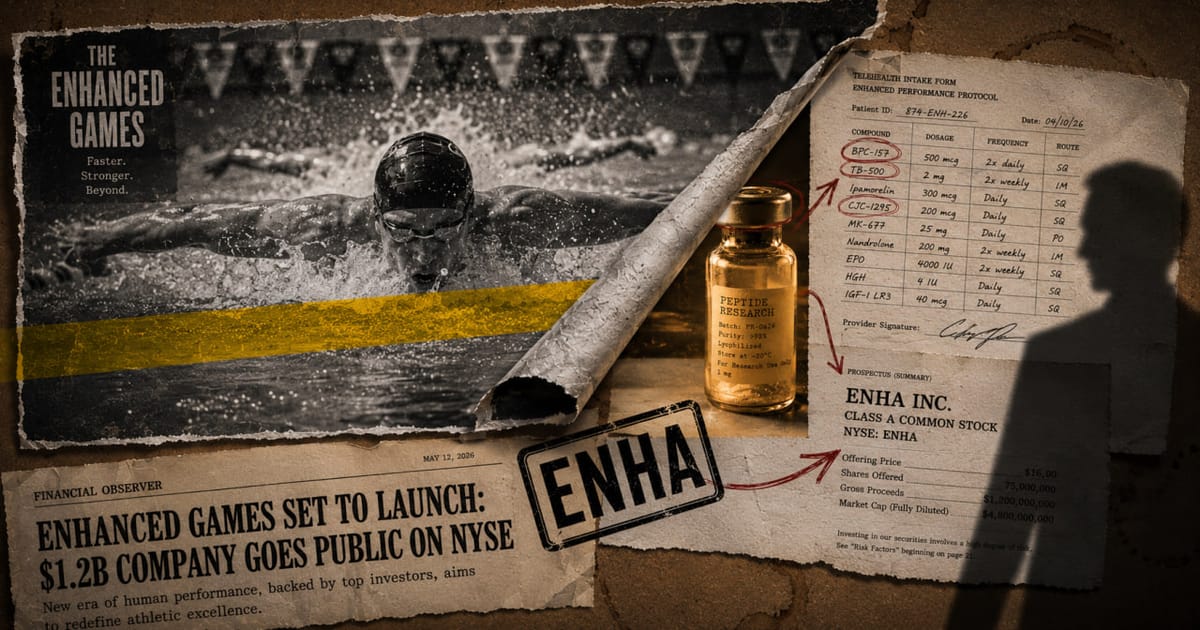
The first gun fires today at Resorts World Las Vegas. Forty elite athletes will race, lift, and swim in front of 2,500 invited guests, and the whole thing will stream free on Roku across North America. The Enhanced Games, the event where performance-enhancing drugs are not just tolerated but encouraged, will have officially happened.
The sports angle is the least interesting part of the story.
What Are the Enhanced Games?
Founded by Australian entrepreneur Aron D'Souza and backed by billionaire Peter Thiel, the Enhanced Games are a multi-sport competition built around one premise: athletes perform better with the full toolkit of modern pharmacology, so let them.
Unlike the Olympic model, where WADA-prohibited substances earn a ban, the Enhanced Games require only that substances are FDA-approved and administered under medical supervision. Anabolic steroids, human growth hormone, peptides, and testosterone are all on the table. Cocaine and heroin are not. According to clinical trial data released by the company, 91% of study participants used testosterone, 79% used human growth hormone, and 62% used stimulants such as Adderall.
Forty athletes compete across four swimming events (50m and 100m freestyle, 50m and 100m butterfly), the 100m sprint, and weightlifting. The prize pool is $25 million, with $250,000 per event winner. Break a world record in the headline events and there is an additional $1 million on top.
Notable names on the roster include American sprinter Fred Kerley and Australian swimming legend James Magnussen. Kerley and U.S. relay swimmer Hunter Armstrong are competing without enhancement, serving as control athletes in the company's clinical study alongside sprinter Tristan Evelyn. That two of the most recognizable names on the roster are running clean says something about how complicated the event's own "enhanced" branding has become.
The evening closes with a deadlift world-record showdown between Thor Björnsson and Mitchell Hooper for $250,000 and the title of strongest drug-unrestricted deadlifter on the planet.
How to Watch
The event streams free globally. Opening events begin at 6:30 PM ET / 3:30 PM PT on YouTube, Rumble, Twitch, and Kick. The main card starts at 9 PM ET / 6 PM PT and is also available on the Roku Channel in North America. No subscription is required on any platform.
The Peptide Play
Here is the part that sports coverage keeps missing. The Enhanced Games is not primarily in the business of selling tickets or media rights. The event is the marketing campaign.
Enhanced Group Inc. went public on the New York Stock Exchange on May 8 under the ticker ENHA, following a de-SPAC deal that valued the company at $1.2 billion. The stock peaked at $14 on listing day before falling to $5.36 by May 22. Its actual revenue model is a direct-to-consumer telehealth platform selling peptides, personalized testosterone, and GLP-1s to the general public. In his shareholder letter, CEO Maximilian Martin described the sporting event as the engine for building "defensible clinical intelligence" to power the company's performance medicine platform.
The timing is not coincidental. RFK Jr., the U.S. Secretary of Health and Human Services, has been publicly advocating to deregulate around 14 previously banned peptides, citing personal use. Enhanced Group is already selling five peptides and has eight more in the pipeline, contingent on that regulatory shift.
Peter Thiel, Balaji Srinivasan, and Christian Angermayer led the seed round, joined by the Winklevoss twins and Saudi prince Khaled bin Alwaleed Al Saud. Donald Trump Jr.'s 1789 Capital co-led the Series B. The investor list reads like a ledger of Silicon Valley libertarianism: people who believe self-optimization is a personal right and the FDA has been more obstacle than guardian. They are not investing because they love swimming. They are investing because they think the consumer market for performance medicine is enormous and underserved.
What the Critics Get Right
The World Anti-Doping Agency and USADA are not wrong about the health risks. USADA chief Travis Tygart called it a "dangerous clown show" and warned that the long-term reality for many PED users includes severe mental health issues, irreversible organ damage, and in documented cases, death.
Anti-doping researchers note that many banned substances are prohibited not just because they improve performance, but because some side effects are, in the words of one specialist, "potentially irreversible." The medical supervision Enhanced Group promises reduces certain risks. It does not eliminate them.
The more uncomfortable concern is structural. Athletes who have aged out of Olympic contracts and endorsement windows face a difficult calculation when a six-figure payout is on the table and the stated price is taking substances under a doctor's care. Whether that constitutes informed choice or financial pressure depends heavily on where an athlete sits in their career and their bank account.
The Real Experiment
Today's event will be measured in world records broken and streaming numbers. The real experiment runs over the next five years: whether a Silicon Valley-style direct-to-consumer pharma platform, built on the back of a live sports spectacle, can normalize the retail market for performance medicine.
If it works, the Enhanced Games will be remembered as one of the more audacious product launches in modern business history. If it does not, it will be filed alongside other Thiel-adjacent ventures that were right about the direction and wrong about the timing.
The starting gun fires today. The business bet takes years to settle.