Elon Musk vs. OpenAI: The Complete Lawsuit Guide, Verdict, and What Comes Next
A plain-English guide to Musk v. Altman: why Musk sued OpenAI, what happened at trial, why the jury ruled in under two hours, and what the 9th Circuit appeal means.

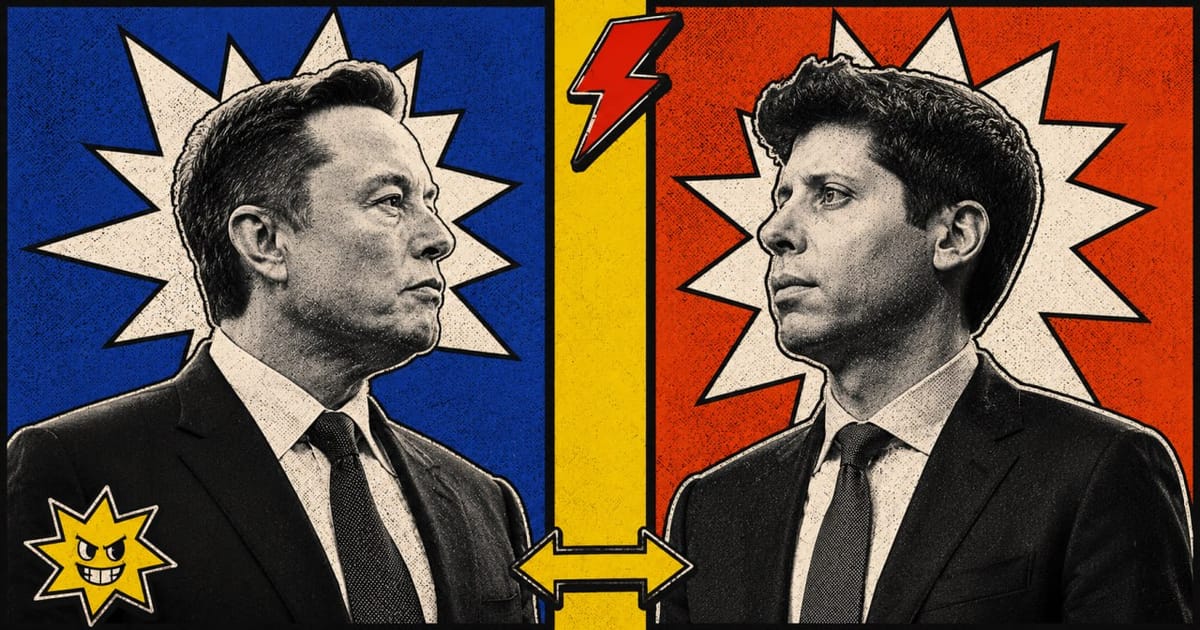
On May 18, 2026, a nine-person advisory jury in Oakland, California unanimously dismissed every legal claim Elon Musk had filed against OpenAI and Sam Altman. The case, formally titled Musk v. Altman, was one of the most closely watched AI-related trials in history. It produced three weeks of testimony from Musk, Altman, Microsoft CEO Satya Nadella, and a parade of OpenAI co-founders. It did not produce an answer to the central question: did OpenAI break a promise to humanity when it shifted from a nonprofit research lab to one of the most commercially valuable companies on earth?
Elon Musk vs. OpenAI: Quick stats
- February 29, 2024: Musk files suit in San Francisco Superior Court
- ~$38 million: Musk's total donations to OpenAI (2016-2020), as stated under oath at trial
- $79-134 billion: Damages Musk sought from OpenAI and Microsoft
- Under two hours: How long the jury deliberated before dismissing all claims on May 18, 2026
- 26%: OpenAI Foundation's equity stake in the restructured OpenAI Group PBC
- ~$852 billion: OpenAI's estimated valuation at the time of the verdict
Table of Contents
- What Is Musk v. Altman?
- How OpenAI Was Founded: The 2015 Promise
- The Power Struggle That Ended the Partnership
- OpenAI's Pivot to Profit: A Timeline
- Why Musk Sued: The Three Core Legal Claims
- The $134 Billion Ask
- Early Court Battles and the Preliminary Injunction
- What OpenAI's Restructuring Actually Changed
- Three Weeks of Trial: Key Testimony
- The Verdict and Why It Took Under Two Hours
- Understanding the Statute of Limitations
- The 9th Circuit Appeal: What Comes Next
- The Question the Courts May Never Answer
- Frequently Asked Questions for Musk v. Altman
What Is Musk v. Altman?
Musk v. Altman is a federal lawsuit filed by Elon Musk in February 2024 against OpenAI, its CEO Sam Altman, its president Greg Brockman, and Microsoft. Musk argued that OpenAI had betrayed the charitable mission on which it was founded in 2015: to develop artificial general intelligence for the benefit of humanity, not for private profit.
On May 18, 2026, a nine-person advisory jury dismissed every claim in under two hours. Not because Musk's core argument was wrong on its face, but because he waited too long to sue. The legal doctrine known as the statute of limitations barred the court from hearing the substance of his claims.
OpenAI, now a company valued at approximately $852 billion as of its March 2026 funding round, completed a major structural overhaul while the lawsuit was pending. Musk has vowed to appeal to the 9th Circuit U.S. Court of Appeals. The underlying question of whether OpenAI broke a founding promise has never been adjudicated on its merits.
How OpenAI Was Founded: The 2015 Promise
OpenAI was founded on December 8, 2015, as a nonprofit artificial intelligence research laboratory. Its co-founders included Musk, Altman, Brockman, Ilya Sutskever, Wojciech Zaremba, and six others. Early backers pledged roughly $1 billion in total commitments, including Peter Thiel, Reid Hoffman, and Amazon Web Services, though significantly less than that was actually transferred to the nonprofit in its early years.
The founding blog post described OpenAI's goal as advancing "digital intelligence in the way that is most likely to benefit humanity as a whole, unconstrained by a need to generate financial return." The 2018 OpenAI Charter later added language that the organization would work to ensure no single company or entity could gain undue control over the world's critical AI technologies. Musk argued at trial that both documents formed the binding promise he believed was broken.
Musk donated approximately $38 million to OpenAI between 2016 and 2020, a figure he stated under oath at trial. He sat on the board and was one of the organization's most prominent public advocates. He consistently argued that his contributions were premised on the nonprofit structure remaining intact.
The Power Struggle That Ended the Partnership
The partnership began fracturing in 2017. Musk, concerned that Google and DeepMind had a substantial compute advantage, pushed to restructure OpenAI around more centralized leadership. In late 2017 and into early 2018, he proposed either taking majority control of the organization himself or merging OpenAI into Tesla, where he would oversee its work.
The other co-founders rejected both proposals. They considered a Tesla merger a direct conflict with OpenAI's independence.
Musk resigned from the OpenAI board on February 21, 2018. The official reason given publicly was a conflict of interest with Tesla's own AI development. Internal communications surfaced during trial painted a different picture: the resignation followed a fundamental disagreement over who should control the company's direction.
Musk described this history plainly under oath. "You can't just steal a charity," he testified repeatedly. Altman directly contradicted that framing in his own testimony: "I never promised Musk to keep the company a nonprofit."
OpenAI's Pivot to Profit: A Timeline
OpenAI's structural evolution from nonprofit to commercial entity happened in stages across six years.
| Year | Event |
|---|---|
| 2019 | OpenAI creates a "capped profit" limited partnership alongside its nonprofit. Investors can earn returns up to 100x; anything above flows back to the nonprofit. |
| 2019 | Microsoft invests $1 billion in the for-profit subsidiary. |
| 2021 | OpenAI releases Codex and API access to GPT-3. Commercial revenue begins in earnest. |
| 2023 | Microsoft's total investment reaches $10 billion across multiple tranches. A January 2023 internal memo projects a $92 billion return on approximately $13 billion invested. |
| November 2023 | OpenAI's board fires and rehires Sam Altman within five days, triggering a governance crisis and renewed scrutiny of the nonprofit-atop-for-profit structure. |
| February 2024 | Musk files suit. |
| October 2025 | OpenAI completes its full recapitalization. The nonprofit becomes OpenAI Foundation with a 26% equity stake. The for-profit entity becomes OpenAI Group PBC, a Public Benefit Corporation. |
Musk's core argument was that this evolution broke the promise made in 2015. OpenAI's position was that adapting the structure was necessary to fund the compute required to remain competitive, and that the nonprofit mission is preserved through the foundation's ongoing oversight role.
Why Musk Sued: The Three Core Legal Claims
Musk filed suit on three primary legal theories. The court later trimmed two of them before trial.
Breach of Charitable Trust
California law allows certain parties to bring a claim that a charitable organization has departed from its founding mission. Musk argued that OpenAI's commercial pivot, its dependence on Microsoft, and its for-profit restructuring constituted a breach of the charitable trust established in 2015. The statute of limitations for this claim under California law is three years.
Unjust Enrichment
Musk argued that by converting a nonprofit into a for-profit entity, the individual defendants and Microsoft received financial windfalls funded in part by his charitable donations. He contended those gains were unjust enrichment at the expense of the charitable mission he helped create. The statute of limitations for this claim is two years.
Antitrust Violations
Musk alleged that Microsoft's deep investment and integration with OpenAI amounted to anticompetitive behavior. These antitrust claims were not part of the jury's May 2026 verdict and remain pending in federal court.
Two additional claims, breach of fiduciary duty and false advertising, did not survive the court's initial review and were excluded before trial.
Musk's Arguments vs. OpenAI's Defense
| Musk's Position | OpenAI's Response |
|---|---|
| OpenAI was built on a charitable promise that Musk funded. | The mission remains. The structure changed to fund necessary compute. |
| The for-profit conversion betrayed the founding charter. | The nonprofit foundation owns 26% and controls the board. |
| Musk was defrauded of his charitable donations. | Musk lost a board control fight in 2018 and is now attacking a competitor. |
| Microsoft's integration is anticompetitive. | Microsoft is a partner among many investors, not a controller. |
| Others received unjust enrichment from assets Musk helped build. | Any harm from structural decisions was visible to Musk years before he sued. |
The $134 Billion Ask
By the time of trial, Musk's lawyers had filed an amended complaint seeking between $79 billion and $134 billion in damages from OpenAI and Microsoft combined. The amended complaint included an unusual request: that any damages awarded be directed to charity rather than to Musk personally.
The framing served two purposes. It deflected the obvious counterargument that Musk was suing a nonprofit he co-founded to extract billions for himself. And it reinforced his argument that the real harm was to the public interest, not his personal balance sheet.
OpenAI countered that the damages figure was itself evidence of bad faith: a $134 billion demand from a man who donated $38 million under oath, filed just as he was building xAI, a direct OpenAI competitor, is not consistent with charitable motivation.
Early Court Battles and the Preliminary Injunction
After filing in San Francisco Superior Court in February 2024, the case moved to federal court on August 5, 2024 and was assigned to U.S. District Judge Yvonne Gonzalez Rogers in Oakland.
In November 2024, Musk sought an emergency preliminary injunction to halt OpenAI's conversion to a Public Benefit Corporation. He argued that once the restructuring was complete, any legal victory he won would be practically irreversible.
At a February 2025 hearing, Judge Rogers called the irreparable harm claim a stretch. Her formal written order denying the injunction followed on March 4, 2025. The conversion proceeded.
In April 2025, OpenAI filed a countersuit against Musk, alleging he had used "every tool available to harm" the company, including orchestrated press campaigns, social media attacks, and what it called a sham bid for OpenAI's assets. In May 2025, the court narrowed the claims heading to trial: fraud and unjust enrichment moved forward; breach of fiduciary duty and false advertising did not.
The California attorney general's office declined to join Musk's lawsuit in April 2025.
What OpenAI's Restructuring Actually Changed
OpenAI's October 2025 recapitalization is central to understanding what the case was actually about. Here is what changed and what did not.
Before: OpenAI Inc. (nonprofit) sat atop OpenAI Global LLC (a capped-profit LLC). Investors could earn up to 100x returns; the nonprofit retained control.
After: OpenAI Foundation (nonprofit) sits atop OpenAI Group PBC (a Public Benefit Corporation). The nonprofit owns approximately 26% of the equity. Microsoft owns approximately 27%.
What a Public Benefit Corporation actually means: A PBC is a for-profit company incorporated under Delaware law with a statutory obligation to balance shareholder returns against a stated public benefit. Unlike a standard C-corporation, its directors have a legal duty to consider that public benefit alongside shareholder returns. Critics argue these obligations are difficult to enforce in practice. Supporters argue the structure is a meaningful legal constraint.
What the attorneys general required: California and Delaware AGs approved the restructuring with conditions: the 26% equity stake for the foundation, OpenAI Foundation's right to appoint all board members, and a pledge of $25 billion toward healthcare and AI resilience over time.
Musk argued the PBC structure does not preserve the founding charitable mission in any meaningful legal sense. OpenAI argued it does, and that the attorney general review process cleared it.
Three Weeks of Trial: Key Testimony
The trial ran from April 28 through May 14, 2026, with closing arguments wrapping on May 14 before the jury delivered its verdict on May 18.
Week One: Musk on the Stand (April 28-30)
Musk testified for three days, repeatedly framing the case with a single line: "You can't just steal a charity." Under cross-examination, Musk admitted that xAI's Grok was trained partly using outputs from OpenAI's models, a process known as distillation. OpenAI's defense used the admission to argue the lawsuit was competitive strategy, not charitable concern.
Week Two: OpenAI's Witnesses (May 5-9)
Greg Brockman testified that his personal stake in OpenAI PBC is worth nearly $30 billion. Shivon Zilis, a former OpenAI board member and mother of four of Musk's children, testified that Musk had offered Sam Altman a seat on the Tesla board as an inducement during the proposed OpenAI-Tesla merger discussions. The detail complicated the narrative that the conflict was purely ideological.
Week Three: Altman and Nadella (May 11-14)
Satya Nadella testified that an email he wrote captured Microsoft's fear of becoming "the next IBM" if it did not align early with a leading AI lab. He said Musk never raised charitable-mission concerns with him directly. A January 2023 memo from Microsoft President Brad Smith to its board, surfaced during Nadella's testimony, projected a $92 billion return on approximately $13 billion invested in OpenAI, a figure that illustrated exactly how commercially valuable the nonprofit's pivot had become.
Altman took the stand last and directly contradicted Musk's founding narrative: "I never promised Musk to keep the company a nonprofit."
The Verdict and Why It Took Under Two Hours
On Monday morning, May 18, 2026, deliberations began at 8:30 a.m. and a verdict was declared at 10:23 a.m. — under two hours from start to finish. The nine-person jury voted unanimously on all claims.
The jury found that Musk's claims were barred by the applicable statutes of limitations.
The breach of charitable trust claim carries a three-year window under California law. The jury found Musk knew or should have known about OpenAI's for-profit structure well before the cutoff date, meaning the clock had expired before his February 2024 filing.
The unjust enrichment claim carries a two-year window. The same finding applied.
Critically, the jury did not rule on whether OpenAI actually broke its founding mission. The case was dismissed entirely on procedural grounds. The underlying merits were never reached.
Judge Rogers concurred and formally dismissed the case. Musk called the result "a calendar technicality," posting on X: "The judge and jury never actually ruled on the merits of the case, just on a calendar technicality." His attorney's statement outside the courthouse was one word: "Appeal."
Understanding the Statute of Limitations
A statute of limitations is a legal deadline for filing a lawsuit. It exists because courts recognize that evidence grows stale over time, memories fade, and defendants should not live under indefinite threat of litigation for events long past.
How it applied here: The jury was asked one central factual question. At what point did Musk know, or should he have known, that OpenAI was operating in a way he now argues violated its charitable trust? If the answer was more than three years before February 2024, the claim is time-barred regardless of whether the underlying conduct was wrong.
The jury concluded Musk had sufficient awareness well before the applicable cutoff. OpenAI's 2019 for-profit conversion was public record. The Microsoft investment was public. Musk had publicly criticized OpenAI on social media for years before filing, behavior OpenAI's lawyers used to argue he understood the structure he was now attacking.
What Musk argues on appeal: Musk's legal team is relying on the "continuing violation doctrine," a legal theory that treats ongoing harmful conduct as restarting the limitations clock. Under this theory, each step in OpenAI's commercial evolution, including the 2025 restructuring itself, would be a fresh violation extending the deadline. Judge Rogers refused to include the continuing violation doctrine in the jury's instructions. Whether that refusal was a reversible legal error is now the central question before the 9th Circuit.
The 9th Circuit Appeal: What Comes Next
Musk filed his notice of appeal to the 9th Circuit U.S. Court of Appeals shortly after the May 2026 verdict. Briefing is expected to run through the rest of 2026; oral arguments, based on typical 9th Circuit scheduling, are estimated for 2027 (no confirmed date has been filed publicly).
For Musk to win, his team needs to persuade a three-judge appellate panel on one of two grounds.
Option 1: Judge Rogers made a legal error by excluding the continuing violation doctrine from jury instructions. The 9th Circuit reviews legal questions de novo, meaning it owes the trial court no deference on this point. If the appellate court agrees the instruction should have been included, the case could be remanded for a new trial where jurors could consider whether each new commercial step reset the limitations clock.
Option 2: There was insufficient evidence to support the jury's factual finding about when Musk had knowledge of the alleged violations. Factual findings receive more deferential review, making this a harder path.
If Musk wins on appeal, the case returns to trial on the merits. For the first time, a court would actually examine whether OpenAI broke its founding charitable mission. That question has implications well beyond this case for AI governance, nonprofit law, and how other research organizations structure commercial relationships.
If the 9th Circuit upholds the dismissal, Musk's legal challenge to OpenAI's commercial trajectory ends. The pending antitrust claims against OpenAI and Microsoft would continue separately.
The Question the Courts May Never Answer
The most important thing about the Musk v. Altman verdict is what it did not decide.
No court has ruled on whether OpenAI's pivot from a nonprofit research lab to a for-profit Public Benefit Corporation was lawful under the terms of its founding charter. No court has answered whether a charitable organization can legally convert to a for-profit structure when the result is that private investors, including Microsoft, stand to receive tens of billions of dollars derived from assets originally donated to a charitable mission.
This is not a trivial question. OpenAI is not the only AI lab watching the outcome. Several of the largest AI research organizations in the world operate under hybrid nonprofit or public-benefit structures. The legal precedent, or the absence of one, that emerges from this case will inform governance decisions across the industry for years.
The Conversation put it plainly in its post-verdict analysis: the jury answered a question about timing, not a question about mission.
The 9th Circuit appeal is the last realistic opportunity for a court to confront the underlying issue. If Musk wins and the case returns to trial, a jury will be asked to evaluate whether a company valued at nearly a trillion dollars, built partly on charitable donations, owes something to the public that funded its founding. If the 9th Circuit upholds the dismissal, that question remains, for the foreseeable future, unanswered.
Frequently Asked Questions for Musk v. Altman
Did Elon Musk win the OpenAI lawsuit?
No. On May 18, 2026, a nine-person jury dismissed every claim Musk filed against OpenAI, Sam Altman, and Microsoft. The claims were barred by the statute of limitations. The court never ruled on whether OpenAI actually betrayed its founding mission.
Why did the jury decide in under two hours?
The statute of limitations question was a narrow factual determination. The jury needed to decide one thing: when did Musk know, or should he have known, about the conduct he was suing over? Once jurors agreed the answer predated the legal deadline, all claims fell simultaneously in under two hours.
What is the statute of limitations and why did it matter?
A statute of limitations is a legal deadline for filing a lawsuit. In California, the deadline for breach of charitable trust is three years and for unjust enrichment is two years. The jury found that Musk had knowledge of OpenAI's for-profit pivot years before his February 2024 filing, making his claims time-barred.
Is Musk appealing? What does he need to prove?
Yes. Musk is appealing to the 9th Circuit U.S. Court of Appeals. His central argument is that Judge Rogers wrongly excluded the "continuing violation doctrine" from jury instructions, a legal theory that would treat each new commercial step by OpenAI as restarting the limitations clock. The 9th Circuit reviews legal rulings like this from scratch, giving Musk a meaningful, if uncertain, path forward.
Did OpenAI betray its founding mission?
No court has ruled on this. The May 2026 verdict was entirely procedural: it dismissed claims based on timing, not substance. Whether OpenAI's commercial evolution constitutes a breach of its 2015 charitable mission is a question no court has yet answered.
What did OpenAI's restructuring actually change?
In October 2025, OpenAI converted from a capped-profit LLC to a Public Benefit Corporation. The original nonprofit became OpenAI Foundation, which owns approximately 26% of the new PBC and retains the right to appoint all board members. Microsoft owns approximately 27%. California and Delaware attorneys general approved the restructuring with governance conditions, including a $25 billion charitable pledge over time.
What is xAI and why does it matter to this case?
xAI is Musk's AI company, founded in 2023 and a direct competitor to OpenAI. At trial, Musk admitted under cross-examination that xAI's Grok was trained partly using outputs from OpenAI's models, a process called distillation. OpenAI's defense used the admission to argue the lawsuit was competitive strategy rather than charitable concern.
What are the antitrust claims and what happens to them?
Musk also alleged that Microsoft's deep investment and integration with OpenAI constitutes anticompetitive behavior. These claims were not part of the jury's May 2026 verdict and remain pending in federal court.
This article reflects the state of Musk v. Altman as of May 24, 2026. The case is pending appeal before the 9th Circuit U.S. Court of Appeals. This page will be updated as the appeal proceeds.
Nothing in this article constitutes legal advice.