SpaceX IPO: The Complete 2026 Guide to SPCX Stock, Valuation, and What Investors Actually Own
SpaceX filed its S-1 on May 20, 2026. Here are the key dates, valuation breakdown, risks, and how retail investors can buy SPCX stock before June 12.

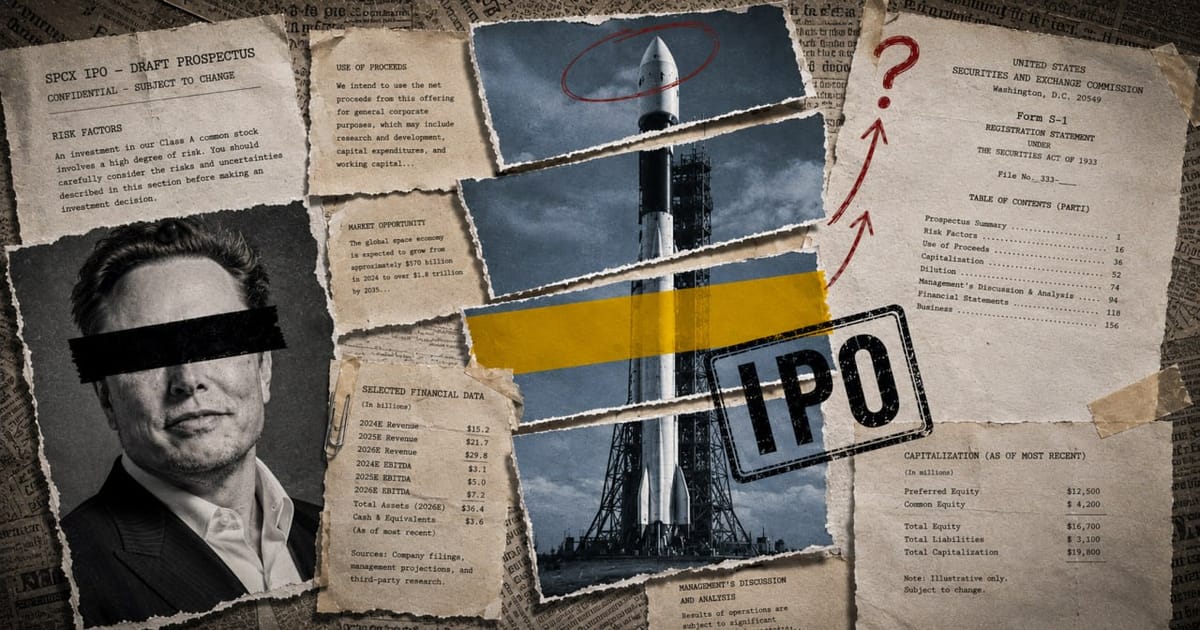
SpaceX filed its S-1 registration statement with the SEC on May 20, 2026, setting up what could be the largest initial public offering in history. The company is seeking to raise up to $80 billion under the ticker SPCX on the Nasdaq, at a valuation between $1.75 trillion and $2 trillion. That would make SpaceX one of the ten most valuable publicly traded companies in the world on its first day of trading, surpassing Saudi Aramco's $29 billion IPO record from 2019 by nearly three times. The same filing that produced those headlines also reveals a $41.3 billion accumulated deficit, an artificial intelligence division that lost more money than the rocket business earned, and a governance structure that gives public shareholders almost no meaningful influence over the company's direction.
SpaceX: Quick stats
- $1.75 trillion target valuation, the largest ever at the time of an IPO
- $80 billion capital raise target, nearly three times Saudi Aramco's 2019 record
- $18.7 billion in 2025 revenue, up 33% from $14.1 billion in 2024
- $4.9 billion net loss in 2025; $41.3 billion accumulated deficit as of March 31, 2026
- 85.1% of voting power retained by Elon Musk post-IPO
- June 12, 2026: expected first day of trading on Nasdaq as SPCX
Table of Contents
- What Is the SpaceX IPO?
- Key Dates: Roadshow, Pricing, and Trading
- SpaceX's Three Business Segments
- Starlink: The Engine Behind the Valuation
- xAI: The $6.4 Billion Drag No One Is Talking About
- The Anthropic Deal: SpaceX's $45 Billion Near-Term Safety Net
- Orbital Data Centers: Opportunity or Liability?
- Starship: The Long-Term Structural Advantage
- What Class A Shareholders Actually Own
- Valuation: Is $1.75 Trillion Justified?
- How to Buy SPCX Stock
- The Payments Angle: Starlink, Stablecoins, and the Global South
- Key Risks
- Frequently Asked Questions for SpaceX IPO
What Is the SpaceX IPO?
SpaceX, formally Space Exploration Technologies Corp., was founded by Elon Musk in 2002 with the stated mission of making human life multiplanetary. For more than two decades it remained private, growing from a scrappy startup that nearly went bankrupt in 2008 to the world's dominant commercial launch provider and the operator of the largest satellite internet network ever built.
The IPO marks the first time retail and institutional investors can own shares in SpaceX directly. The company will list Class A common shares on the Nasdaq stock exchange under the ticker SPCX and will also trade on the newly launched Nasdaq Texas exchange. Goldman Sachs is leading the underwriting, with Morgan Stanley, Bank of America, Citi, and JPMorgan also named in the filing.
At the $1.75 trillion midpoint of the expected valuation range, SpaceX would debut as one of the ten largest publicly traded companies in the world, above Amazon's current market cap and below Apple's.
Key Dates: Roadshow, Pricing, and Trading
- April 1, 2026: SpaceX submitted a confidential draft registration statement to the SEC
- May 20, 2026: Public S-1 filing released; financial details became available for the first time
- June 4, 2026: Investor roadshow begins, with SpaceX executives pitching institutional investors
- June 11, 2026: IPO pricing, when the final share price and exact valuation will be set
- June 12, 2026: Shares begin trading on Nasdaq and Nasdaq Texas as SPCX
The window between pricing and trading is tight. Investors who secure shares at the IPO price on June 11 will see their first market price the following morning. High-profile IPOs routinely see significant swings on the first day of trading in either direction.
SpaceX's Three Business Segments
SpaceX's February 2026 merger with Elon Musk's artificial intelligence company xAI significantly expanded both the company's footprint and its losses. The consolidated entity now operates across three main segments.
Connectivity (Starlink). The satellite internet division accounts for more than two-thirds of total company revenue and is the only segment currently generating consistent operating profit. Starlink's financial performance underpins virtually the entire $1.75 trillion valuation thesis.
Launch Services (Falcon 9). The rocket launch business that made SpaceX famous. This covers commercial satellite launches, NASA crew and cargo missions to the International Space Station, and Department of Defense payload delivery. Government contracts represent approximately 35% of total company revenue, providing a stable institutional base.
Development (Starship and xAI). SpaceX is developing Starship, its next-generation rocket targeting dramatic reductions in launch cost. The xAI division, home to the Grok chatbot, the Colossus supercomputing cluster, and X (the social media platform formerly known as Twitter), was added through the February 2026 merger and now represents the company's largest capital expenditure by a wide margin.
Starlink: The Engine Behind the Valuation
Starlink is the financial core of the SpaceX IPO story, and its numbers are genuinely impressive. The division generated $11.4 billion in revenue in 2025, a 49.8% increase year over year, with operating income of $4.4 billion and adjusted EBITDA of $7.2 billion. In the first quarter of 2026 alone, Starlink generated $3.3 billion in revenue and $1.2 billion in operating profit.
As of March 31, 2026, Starlink had 10.3 million subscribers and more than 9,600 satellites in orbit. Subscriber growth is fastest in emerging markets, where Starlink often represents the only viable broadband option against slow or absent ground-based infrastructure.
Starlink's structural advantage is vertical integration. SpaceX launches its own satellites on its own rockets, which means the cost to expand the constellation is dramatically lower than it would be for a competitor relying on third-party launch providers. That advantage compounds further as Starship enters commercial service, with its target launch cost of roughly $100 per kilogram compared to approximately $2,500 per kilogram on Falcon 9.
Amazon's Project Kuiper is the most credible competitive threat. Kuiper began commercial launches in 2025, but it is years behind Starlink in subscriber scale and relies on United Launch Alliance and Blue Origin for launches rather than a vertically integrated system.
xAI: The $6.4 Billion Drag No One Is Talking About
The most underreported number in SpaceX's S-1 filing is this: xAI generated $3.2 billion in revenue in 2025 while posting a $6.4 billion operating loss. The division's capital expenditures reached $12.7 billion, more than three times the spending on SpaceX's entire rocket operations.
To put that in context: xAI's losses in 2025 alone exceeded SpaceX's total company net loss of $4.9 billion for the year. Every public shareholder who buys SPCX stock on June 12 owns a proportional share of those AI losses going forward, with no ability to vote out the management team responsible for incurring them.
SpaceX completed its merger with xAI in February 2026. The deal bundled together the Grok chatbot, the Colossus supercomputing cluster in Memphis, Tennessee, and X, the social media platform. It also brought regulatory exposure. The S-1 discloses approximately $530 million in potential legal liability tied to pending matters, including an Irish Data Protection Commission inquiry into Grok's handling of European children's data and separate allegations that the chatbot generated nonconsensual sexualized images.
For investors evaluating the $1.75 trillion valuation, xAI is simultaneously the company's largest growth bet and its most open liability.
The Anthropic Deal: SpaceX's $45 Billion Near-Term Safety Net
One number changes the near-term revenue picture for xAI considerably: Anthropic is paying SpaceX $1.25 billion per month for access to the Colossus data centers through May 2029.
Over the full contract term, that totals approximately $45 billion, making it one of the largest AI compute agreements ever signed anywhere. Anthropic gains access to the full capacity of Colossus 1 in Memphis, including more than 220,000 NVIDIA GPUs and 300 megawatts of compute power. The deal has since expanded to include Colossus 2, which houses next-generation NVIDIA GB200 hardware.
The contract creates a near-term offset against xAI's enormous development costs. With $1.25 billion arriving every month through 2029, the data center buildout becomes substantially less of a drag on consolidated financials, at least in the medium term.
Two risks are worth flagging. First, either party can terminate the agreement with 90 days of notice. If Anthropic exits before the contract runs its course, SpaceX loses a revenue anchor equivalent to roughly 80% of a full quarter of Starlink revenue. Second, the deal is with a single customer. Anthropic has expressed interest in partnering with SpaceX on orbital data center capacity, which ties closely into the most speculative element of the IPO story.
Orbital Data Centers: Opportunity or Liability?
The most speculative element of SpaceX's IPO is its plan to put AI data centers in orbit. In January 2026, SpaceX filed an FCC application to launch up to one million data center satellites, potentially as early as 2028. The S-1 claims a total addressable market of $28.5 trillion, with $22.7 trillion attributed to enterprise AI applications.
SpaceX's own prospectus contains a direct admission: these data centers "may never be commercially viable."
Scientists and satellite engineers have questioned the physics openly. Data centers generate enormous heat, managed on Earth through air and liquid cooling systems. In orbit, without convection, removing heat from densely packed server hardware is an engineering challenge that has not been solved at commercial scale. Latency constraints for AI inference workloads and satellite servicing costs add further uncertainty.
The $22.7 trillion TAM figure that drives a significant portion of the $1.75 trillion valuation rests, at least partly, on SpaceX solving these problems before a better-funded competitor does.
This does not make the orbital data center vision worthless. SpaceX has solved problems critics once called impossible, most notably reusable orbital rockets. But investors should treat it as a venture-stage bet embedded inside a trillion-dollar valuation, not a near-term revenue line.
Starship: The Long-Term Structural Advantage
Starlink pays the bills today. Starship is the reason SpaceX believes it can sustain and grow a $1.75 trillion valuation over time.
Falcon 9 delivers payload to orbit at approximately $2,500 per kilogram. SpaceX's engineering target for Starship is roughly $100 per kilogram, a reduction of approximately 96%. Achieving that at commercial scale would reshape the economics of every space-based business: Starlink constellation expansion, government contracts, and any future orbital infrastructure would all become dramatically cheaper to operate.
SpaceX spent $3 billion developing Starship in 2025 and another $930 million in the first quarter of 2026. The company expects to begin commercial payload delivery in the second half of 2026, with NASA Artemis lunar missions and Department of Defense contracts as early customers.
For long-term investors, Starship is the thesis. For short-term investors, it is a spending line that currently produces no revenue and has slipped its target timeline multiple times.
What Class A Shareholders Actually Own
SpaceX's IPO uses a dual-class share structure. Understanding what public investors do and do not receive is essential before committing capital.
Class A shares, the ones sold to the public, carry one vote per share. Class B shares, held by Musk and other insiders, carry 10 votes per share. Class B shareholders can elect a majority of the board of directors regardless of the overall vote count.
Musk holds approximately 850 million Class A shares and nearly 5.6 billion Class B shares, giving him roughly 42% of SpaceX's equity and 85.1% of its voting power. He serves as CEO, CTO, and board chair simultaneously, and no shareholder vote can change any of that without his consent.
Musk's compensation package adds a further dimension. He was granted 1 billion additional Class B shares, which he can already vote despite having no vested economic value in them yet. Those shares do not vest unless SpaceX reaches a $7.5 trillion valuation and Musk achieves "the establishment of a permanent human colony on Mars with at least one million inhabitants."
| Company | Founder voting control | Share class differential |
|---|---|---|
| SpaceX (SPCX) | 85.1% (Elon Musk) | Class B: 10x votes vs Class A |
| Meta (META) | ~61% (Mark Zuckerberg) | Class B: 10x votes vs Class A |
| Alphabet (GOOGL) | ~51% (Page and Brin) | Class B: 10x votes vs Class A; Class C: 0 votes |
| Snap (SNAP) | ~97% (Spiegel and Murphy) | Class C: 10x votes vs Class A; Class B: 9x votes |
The practical implication: a retail investor who buys SPCX shares owns a proportional claim on SpaceX's cash flows but cannot meaningfully influence board composition, strategic direction, executive compensation, or decisions about the xAI division's continued losses. The governance structure is closer to a bond with equity upside than a traditional voting common share.
Valuation: Is $1.75 Trillion Justified?
At $1.75 trillion, SpaceX is priced at approximately 94 times its 2025 revenue of $18.7 billion. That multiple prices in significant future growth across multiple business lines simultaneously.
NYU finance professor Aswath Damodaran published a three-segment valuation of SpaceX ahead of the IPO. His model, built around an assumption of $320 billion in future peak revenue across Starlink, launch services, and xAI with operating margins approaching 50% at maturity, discounted at an 8% cost of capital, arrived at an intrinsic value of $1.22 trillion. That is roughly $530 billion below the IPO asking price.
Damodaran noted two things that matter. First, uncertainty in SpaceX's business is unusually high, meaning the $1.22 trillion figure carries a wide range. Second, that uncertainty skews asymmetrically toward the upside: there is more potential upside than downside risk, which means $1.75 trillion falls within a defensible range even if it represents the optimistic case.
| Scenario | Implied valuation | Key assumptions |
|---|---|---|
| Bear case | $600B to $800B | xAI losses persist, orbital data centers unviable, Kuiper erodes Starlink share |
| Base case (Damodaran) | $1.22 trillion | Starlink continues growing, Starship commercializes, xAI reaches breakeven |
| IPO ask | $1.75 trillion | Bull case baked in; orbital AI and Starship contribute material future revenue |
| Bull case | $3 trillion+ | Starship achieves mass deployment, orbital data centers generate revenue, Grok captures enterprise AI share |
For comparison: Saudi Aramco raised $29 billion at a $1.7 trillion valuation in 2019, making it the previous record holder for largest IPO. Facebook raised $16 billion at an $81 billion valuation in 2012. SpaceX at $80 billion would raise five times what Facebook raised at more than 21 times Facebook's IPO valuation.
The honest answer is that $1.75 trillion is a reasonable price for the bull case and a steep price for the base case. Investors should decide which scenario they are actually paying for.
How to Buy SPCX Stock
At the IPO price (June 11). SpaceX has reportedly allocated up to 30% of the offering for retail investors through Robinhood, Fidelity, and Charles Schwab. That is a significantly higher retail allocation than the typical 5-10% in major IPOs. Given the demand expected for SpaceX, applications will likely far exceed available shares, meaning most retail applicants will receive partial fills or none at all.
After June 12. SPCX shares will trade on Nasdaq and Nasdaq Texas during regular market hours. Any brokerage account with access to Nasdaq-listed equities can purchase shares at market prices once trading opens. First-day pricing in high-profile IPOs has historically been volatile in both directions.
Before June 12 (accredited investors only). Private secondary marketplaces including Forge Global, EquityZen, Hiive, and Nasdaq Private Market have facilitated SpaceX share transactions for years. As of May 23, 2026, Forge Global was pricing SpaceX shares at $652.93. These platforms are restricted to accredited investors and carry higher transaction costs and lower liquidity than public markets.
Investors who want SPCX exposure without first-day volatility may prefer to wait for the market to find its initial trading range before buying.
This section is informational only and does not constitute financial or investment advice. Consider consulting a licensed financial advisor before making investment decisions.
The Payments Angle: Starlink, Stablecoins, and the Global South
This is the angle virtually no major financial outlet has covered in the SpaceX IPO context.
As Starlink scaled into emerging markets across Africa, Latin America, and Asia, it ran into a fundamental problem: collecting subscription payments where traditional banking infrastructure is unreliable, expensive, or inaccessible. International wire transfers in these regions typically carry fees of 5-10% and can take days to settle. Local banks routinely block or delay cross-border payments.
SpaceX solved this through a partnership with Bridge, a stablecoin payments platform. Instead of routing subscription revenue through legacy correspondent banking rails, Starlink accepts local currency payments and converts them into stablecoins for global treasury management. Bridge was subsequently acquired by Stripe for more than $1 billion, a signal of how central stablecoin payment infrastructure has become for global fintech.
The global stablecoin market has reached approximately $205 billion. For readers tracking crypto and payments, the Starlink-Bridge relationship represents one of the largest real-world deployments of stablecoin infrastructure to date, embedded inside a company that is about to begin trading publicly.
As Starlink continues expanding into markets where stablecoin payment rails are already the default for cross-border commerce, this infrastructure choice is more than a billing detail. It creates a payments moat that no satellite internet competitor has replicated or disclosed a comparable strategy for. Starlink is not just a connectivity product in these markets; it is also a gateway to financial access, and stablecoins are the mechanism that makes the economics work.
Key Risks
SpaceX's S-1 includes 38 pages of risk factors. The most material for investors are:
Musk concentration risk. With 85.1% voting control and simultaneous roles as CEO, CTO, and board chair, the company's direction depends entirely on one person's judgment and continued involvement. The S-1 names Musk's other responsibilities at Tesla, X, and xAI as competing demands on his time.
xAI regulatory exposure. The approximately $530 million in disclosed legal liabilities tied to Grok's data practices could grow. European regulators have been aggressive in applying GDPR and child-safety rules to AI systems, and the Irish DPC inquiry is ongoing.
Government contract dependency. About 35% of revenue flows from NASA and Department of Defense contracts. Any shift in federal space policy or budget priorities creates direct revenue risk, particularly in a period of government spending scrutiny.
Orbital data center uncertainty. SpaceX's own S-1 admits viability is not guaranteed. If the orbital data center business never generates commercial revenue, the $22.7 trillion TAM claim that supports a significant portion of the $1.75 trillion valuation is unfounded.
Valuation multiple. At 94x 2025 revenue, the stock prices in flawless execution across multiple speculative initiatives simultaneously. Any miss on Starlink growth, Starship timelines, or xAI profitability trajectory could compress the multiple significantly.
Starship execution. Commercial payload delivery is targeted for H2 2026 but has slipped before. Further delays push out the timeline on every Starship-dependent revenue stream, including lower-cost constellation expansion and lunar mission contracts.
Amazon Kuiper competition. Kuiper has Amazon's distribution network, cloud infrastructure, and capital to compete directly with Starlink for enterprise and government contracts.
Anthropic termination clause. Either party can exit the $45 billion compute contract with 90 days of notice. Loss of that anchor contract would change SpaceX's near-term financial picture materially.
Frequently Asked Questions for SpaceX IPO
What ticker symbol is SpaceX?
SpaceX will trade under the ticker symbol SPCX on the Nasdaq stock exchange and on the Nasdaq Texas exchange starting June 12, 2026.
When does the SpaceX IPO?
SpaceX expects to begin trading on June 12, 2026, following a roadshow starting June 4 and IPO pricing on June 11.
What is the SpaceX IPO price per share?
The final price per share will be set during the pricing process on June 11, 2026. SpaceX is targeting a valuation of $1.75 trillion to $2 trillion; the exact share price depends on the total share count disclosed in the final prospectus.
Is SpaceX profitable?
SpaceX's Starlink division is profitable, generating $1.2 billion in operating profit in Q1 2026, but the consolidated company reported a $4.9 billion net loss in 2025, driven primarily by xAI losses and Starship development spending.
How much of SpaceX does Elon Musk own?
Musk holds approximately 42% of SpaceX's equity and controls 85.1% of its voting power through a dual-class share structure where his Class B shares carry 10 votes each versus one vote per Class A public share.
Can retail investors buy SpaceX IPO shares at the IPO price?
Yes, in limited quantities. SpaceX has reportedly allocated up to 30% of shares to retail investors through Robinhood, Fidelity, and Charles Schwab, far above the typical 5-10% retail allocation. Demand is expected to significantly exceed supply, so many applicants will receive partial fills or nothing.
What is the SpaceX IPO valuation?
SpaceX is targeting a valuation of $1.75 trillion, which would make it one of the ten most valuable publicly traded companies in the world at debut.
Is the SpaceX IPO a good investment?
That depends on the scenario you are paying for. NYU professor Aswath Damodaran's base-case model values SpaceX at $1.22 trillion, about $530 billion below the $1.75 trillion IPO price. The asking price reflects the bull case, where Starship commercializes at scale, orbital data centers generate revenue, and xAI reaches profitability. Anyone considering a significant investment should consult a licensed financial advisor.
This article is for informational purposes only and does not constitute financial, investment, or legal advice. Cryptocurrency and equity markets involve risk, including the potential loss of principal. Always conduct your own research and consider consulting a licensed financial advisor before making investment decisions.