USDT vs USDC in 2026: Which Stablecoin Leads and Why It Matters
USDT holds more. USDC moves more. Compare reserves, GENIUS Act compliance, MiCA access, and transaction volume for 2026's two biggest stablecoins.

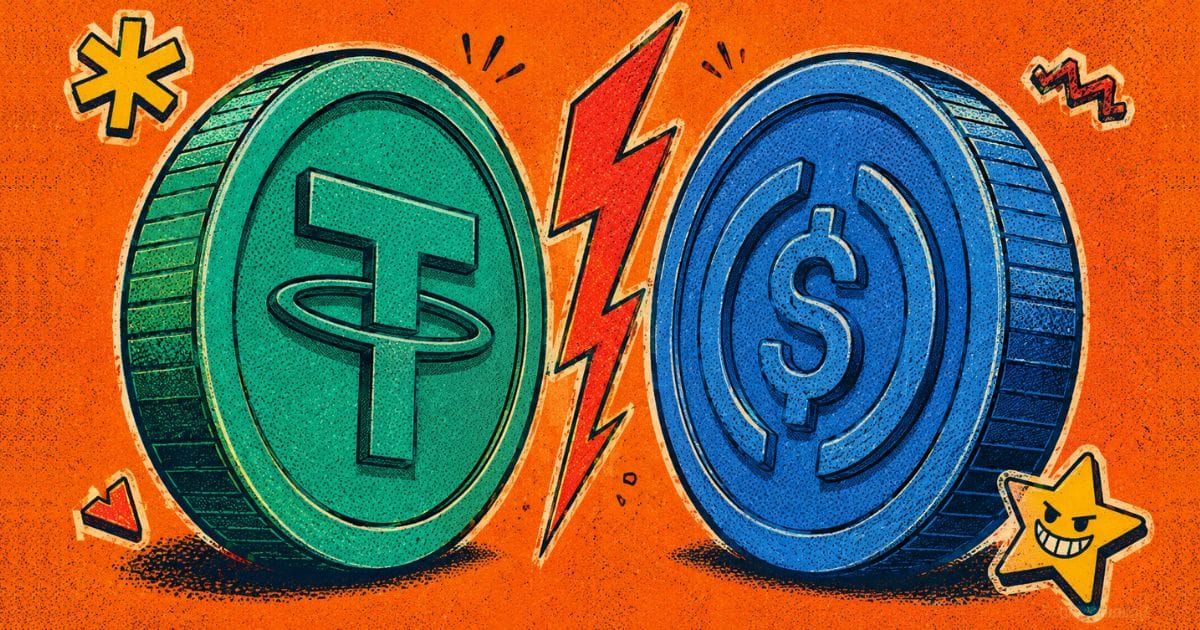
Tether holds more. Circle moves more. Here is how the two largest stablecoins are dividing the $300 billion market in 2026, and where each one is losing ground.
The stablecoin market crossed $300 billion in total capitalization in 2026. Two coins account for most of it. USDT and USDC are not simply competing. They are sorting into distinct roles, serving different markets, and operating under increasingly different regulatory conditions. Choosing between them is no longer just a preference. It is a compliance question, a geography question, and increasingly a legal one.
USDT is the stablecoin that built the market. Tether launched in 2014 and spent a decade becoming the default quote currency on every major crypto exchange. Today its outstanding supply sits at $183.5 billion, confirmed in its most recent quarterly attestation by BDO Italia. In emerging markets from Turkey to Argentina to Vietnam, people hold USDT the way they hold physical dollars, as protection against local currency devaluation. That structural demand keeps Tether's supply growing even as its share of on-chain transaction volume declines.
USDC is winning the compliance race. Circle's coin processed more on-chain volume than USDT in Q1 2026: $2.55 trillion against $1.49 trillion, despite holding less than half of USDT's outstanding supply. That gap reflects where USDC has entrenched itself: institutional settlement, DeFi protocols, and regulated payment infrastructure where monthly audits and a regulated parent company are baseline requirements. Since Circle listed on the NYSE in June 2025, USDC also carries something USDT cannot match: a publicly traded issuer filing quarterly disclosures with the SEC.
What follows covers every meaningful data point separating the two coins in 2026: reserve composition, attestation standards, the GENIUS Act compliance gap, MiCA's exclusion of USDT from European exchanges, and where each coin holds its strongest ground. All figures are drawn from the primary documents: Tether's Q1 2026 BDO attestation, Circle's Deloitte transparency reports, Visa Onchain Analytics, and the GENIUS Act text itself.
Table of Contents
- The Numbers at a Glance
- USDT: How the Market Leader Got Here
- USDC: The Regulated Challenger Gaining Ground
- The GENIUS Act: How US Law Reshapes Both
- MiCA and the European Divide
- Where Each Stablecoin Dominates
- The Audit Question
- USDT vs USDC: Head-to-Head Comparison
- Frequently Asked Questions
- The Bottom Line
The Numbers at a Glance
Two numbers define the stablecoin market in 2026.
Tether's USDT: $183.5 billion in outstanding supply as of March 31, 2026, confirmed in the Q1 2026 attestation prepared by BDO Italia. The largest stablecoin by a distance. Dominant on every major exchange. Anchored to emerging market demand and crypto trading pairs worldwide.
Circle's USDC: approximately $77 billion in market cap, up 72% year over year. And in Q1 2026, USDC processed $2.55 trillion in on-chain transaction volume versus USDT's $1.49 trillion, accounting for 63% of all stablecoin transaction volume in the quarter, according to Visa Onchain Analytics. That is nearly two-thirds of the market's movement going through one coin that held less than half of USDT's outstanding supply.
Those two facts say different things about what each coin is actually used for.
| Metric | USDT (Tether) | USDC (Circle) |
|---|---|---|
| Outstanding Supply (Q1 2026) | $183.5B (per BDO attestation) | ~$77B |
| Market Cap YoY Change | ~+28% | ~+72% |
| Q1 2026 Transaction Volume | $1.49 trillion | $2.55 trillion |
| Share of Stablecoin Volume | ~37% | ~63% |
| Primary Blockchains | Tron, Ethereum, Stable | Ethereum, Solana, Base, Arc |
| Attestation Frequency | Quarterly (BDO Italia) | Monthly (Deloitte) |
| Issuer Headquarters | El Salvador | United States of America |
| Publicly Traded | No | Yes (NYSE: CRCL, June 2025) |
| GENIUS Act Compliant | Partial (deadline Jan 2027) | Yes |
| MiCA Compliant (EU) | No | Yes |
USDT: How the Market Leader Got Here
Tether launched in 2014. For years it was the only liquid dollar proxy on crypto exchanges. When bitcoin traders wanted to move into dollars without touching a bank, USDT was the answer. That structural advantage compounded over a decade.
Today, USDT is the base trading pair on virtually every major centralized exchange. In emerging markets, particularly Turkey, Argentina, Southeast Asia, and sub-Saharan Africa, USDT has become a substitute savings instrument. People hold it not to trade crypto but to hold dollars outside a local banking system they do not trust.
That use case explains why USDT's supply keeps growing even as its transaction volume share falls. Tether is being held more than it is being moved.
Reserves and Transparency in 2026
Tether's Q1 2026 reserve attestation, prepared by BDO Italia, shows total assets of $191.8 billion against $183.5 billion in token-related liabilities. The key line items:
- US Treasuries and Treasury-equivalent instruments: approximately $141 billion, consisting of $117 billion in Treasury bills and a further $24 billion in overnight and term reverse repurchase agreements backed by Treasuries. That makes Tether one of the largest single holders of US government debt in the world
- Gold (physical): approximately $20 billion
- Bitcoin: approximately $7 billion
- Secured loans and other investments: the remaining balance, with counterparty details not publicly disclosed
Total reserve buffer over liabilities: $8.23 billion. That is the amount by which assets exceed the outstanding USDT supply.
The attestation is prepared under the ISAE 3000 (Revised) standard. It is not a full financial audit. It is a point-in-time verification that assets exceed liabilities, not a forensic review of internal controls or counterparty quality.
In March 2026, Tether announced it had engaged a Big Four accounting firm for a full audit of its reserves. The firm's name was later revealed to be KPMG. It is the most significant transparency commitment in Tether's history. For years, the absence of a Big Four audit was the loudest criticism leveled at the company. If the audit publishes before the GENIUS Act's January 2027 compliance deadline, it removes the single largest reputational overhang Tether carries.
The Profitability Machine
Tether generated $1.04 billion in net profit in Q1 2026. That number needs context.
The company holds approximately $141 billion in US Treasuries and Treasury-equivalent instruments. At current rates, those holdings generate significant interest income every quarter. Because Tether does not pay interest to USDT holders, that yield flows directly to the company's bottom line.
The $8.23 billion reserve buffer, built from retained profits over time, is the cushion that absorbs losses before any USDT holder is affected.
USDC: The Regulated Challenger Gaining Ground
Circle launched USDC in 2018 in partnership with Coinbase through the Centre Consortium. It was designed from the start to be the compliant stablecoin: monthly attestations, a US-regulated structure, and a reserve model limited to cash and short-dated Treasuries.
For four years, USDC grew steadily but could not close the gap on USDT. Then three things happened in quick succession.
First: Circle engaged Deloitte for monthly reserve attestations. Deloitte verifies the Circle Reserve Fund, a SEC-registered 2a-7 money market fund managed by BlackRock. The fund holds approximately 80% in short-dated US Treasuries and 20% in cash at regulated US banks. The attestations are published monthly and available publicly.
Second: In March 2023, USDC briefly traded at $0.87 on secondary markets when Silicon Valley Bank failed. Circle had $3.3 billion in cash reserves held at SVB, roughly 8% of USDC's reserves at the time. The US government backstopped SVB depositors that weekend, Circle recovered in full, and USDC returned to its peg by March 13. Circle responded by diversifying its banking relationships across multiple institutions.
Third: On June 5, 2025, Circle listed on the New York Stock Exchange under the ticker CRCL. The IPO priced at $31 per share and surged 168% on day one, closing at $83.23. A public company must file quarterly 10-Q and annual 10-K disclosures with the SEC, answer to institutional shareholders, and operate under scrutiny that a private company never faces. For enterprise customers and regulators, NYSE: CRCL is a signal that Circle is not going anywhere.
Volume Overtakes Tether
The Q1 2026 volume data from Visa Onchain Analytics is harder to explain away than market cap.
USDC processed $2.55 trillion in on-chain transaction volume in Q1 2026. USDT processed $1.49 trillion. That is the first time USDC has led on raw on-chain volume since 2019.
The leading explanation: USDC has become the preferred settlement layer for institutional payments, DeFi protocols, and cross-border transactions. Those use cases generate high transaction frequency with shorter hold periods. USDT is held longer, particularly in emerging markets where it functions as a savings instrument, which shows up in outstanding supply but not in velocity.
For payment infrastructure builders, velocity is the number that matters. A stablecoin that moves is a stablecoin that earns its place in a settlement stack.
The GENIUS Act: How US Law Reshapes Both
The Guiding and Establishing National Innovation for US Stablecoins Act, known as the GENIUS Act, was signed into law on July 18, 2025. It is the first comprehensive federal stablecoin framework in US history.
The core requirements under the Act:
- 1:1 reserves: Every stablecoin dollar must be backed by one dollar in high-quality liquid assets: US dollars, short-dated Treasuries, repos backed by Treasuries, or government money market funds. No fractional reserves.
- Monthly public disclosures: Issuers must publish the composition of their reserves monthly, verified by a registered public accounting firm, with monthly CEO and CFO certifications filed with their regulator.
- Insolvency protections: The Act amends the US Bankruptcy Code so that reserve assets are not part of the bankruptcy estate and are preserved for stablecoin holders. In a deficiency scenario, the Act grants stablecoin holders a super-priority claim above general unsecured creditors.
- Compliance deadline: January 2027, or 120 days after final implementing rules are published, whichever is later.
For USDC, the GENIUS Act largely codifies what Circle already does. Monthly Deloitte attestations, 1:1 reserves in Treasuries and cash, and US regulatory oversight were already in place. The law does not require Circle to change much. If anything, it creates a moat around compliant issuers by raising the floor for anyone trying to launch a competing dollar stablecoin.
For USDT, the picture is different. Tether operates from El Salvador. Its reserves include gold and bitcoin alongside Treasuries. Its attestations are quarterly, not monthly. None of those facts make USDT illegal to hold today, but they may not satisfy GENIUS Act standards for issuers seeking to operate in the US market after January 2027.
Tether has not confirmed whether it will seek compliance under the GENIUS Act. If US exchanges eventually face pressure to restrict non-compliant stablecoins, that is a meaningful distribution risk for Tether in its second-largest market.
MiCA and the European Divide
The EU's Markets in Crypto-Assets regulation created the sharpest geographic split in stablecoin history.
MiCA requires stablecoins offered in the EU to be issued by a regulated entity authorized by a national competent authority within the EU. Tether has not pursued that authorization. The delisting timeline among major regulated exchanges:
- December 2024: Coinbase EU delisted USDT
- January 31, 2025: Crypto.com ended USDT availability for EU users
- March 31, 2025: Binance removed nine stablecoins including USDT for EEA users; Kraken moved USDT to sell-only mode before full delisting
By mid-2026, European retail and institutional traders using licensed EU platforms cannot buy USDT. They can sell existing holdings, but new positions require an alternative.
USDC is fully MiCA-compliant. So is Circle's euro-pegged EURC. Those two products are the direct beneficiaries of every USDT delisting on EU platforms.
For the broader stablecoin market, MiCA is a forcing function. Europe's crypto market is large enough that losing it is a real cost. Tether has said MiCA compliance is complex and that it continues to evaluate its options.
July 1, 2026 marks the end of national transitional provisions for crypto-asset service providers in the EU. After that date, only MiCA-authorized firms can operate. How aggressively national regulators pursue remaining non-compliant activity after that deadline is the open question.
Where Each Stablecoin Dominates
USDT: Trading and Emerging Markets
USDT's strongholds are exchange trading pairs and emerging market dollar holdings.
On Binance, Bybit, OKX, and most major offshore exchanges, USDT is the primary quote currency. When a trader wants to go long on a new token, they buy it with USDT. When they exit, they receive USDT. That trading infrastructure lock-in is deep and sticky. Exchanges would need significant incentive to reprice thousands of markets in a different stablecoin.
In emerging markets, USDT's lead is similarly entrenched. Turkey, Argentina, Vietnam, Nigeria, and dozens of other countries have active USDT peer-to-peer markets where people buy and sell dollars directly. Tether's Tron-based USDT, with lower transaction fees than Ethereum, dominates this segment. USDC has minimal presence here.
USDC: Institutions, DeFi, and Payments
USDC's strongholds are institutional settlement, DeFi protocols, and regulated payment infrastructure.
Major DeFi protocols on Ethereum and Solana, including Aave, Compound, and Uniswap, hold large USDC reserves. Institutions that need on-chain dollar exposure with an auditable, regulated counterparty default to USDC.
In payments, USDC is the settlement layer of choice for companies building stablecoin payment rails. The rationale is straightforward: monthly Deloitte attestations, reserves limited to Treasuries and cash, full MiCA compliance, and a publicly traded parent company that carries SEC disclosure obligations.
For US-regulated businesses, using USDC for payments removes a compliance question that USDT still carries.
The Audit Question
The single most important unresolved issue in the USDT vs USDC debate is the audit.
Circle: Monthly attestations by Deloitte verify the Circle Reserve Fund, a SEC-registered 2a-7 money market fund. The 2a-7 structure is among the most regulated fund vehicles in US finance. Holdings are disclosed publicly. Deloitte's attestations confirm that USDC in circulation is matched by reserve assets as of each reporting date.
Tether: Quarterly attestations by BDO Italia confirm that assets exceed liabilities. They do not constitute a full financial audit. The secured loan portion of Tether's reserves, the amount not held in Treasuries, gold, or bitcoin, does not include public disclosure of counterparties or collateral terms. Critics have long argued that without knowing who borrowed against those assets and what collateral backs them, the reserve picture is incomplete.
Tether's March 24, 2026 announcement that it had engaged a Big Four firm for a full audit is the most significant transparency development in the company's history. The firm's name has not been disclosed. If the audit publishes a clean opinion before the GENIUS Act's January 2027 deadline, it would close the last major credibility gap between Tether and Circle.
Until that audit lands, USDT holders accept a degree of opacity that USDC holders do not.
USDT vs USDC: Head-to-Head Comparison
| Category | USDT | USDC | Edge |
|---|---|---|---|
| Outstanding Supply (Q1 2026) | $183.5B (BDO attested) | ~$77B | USDT |
| Q1 2026 Transaction Volume | $1.49T | $2.55T | USDC |
| Reserve Transparency | Quarterly (BDO Italia, ISAE 3000) | Monthly (Deloitte, AICPA standards) | USDC |
| Reserve Composition | Treasuries (~$141B), gold, bitcoin, other | Treasuries + cash (2a-7 fund only) | USDC |
| Reserve Buffer | $8.23B above liabilities | Fully backed, no disclosed excess buffer | USDT |
| Q1 2026 Net Profit | $1.04B (per BDO attestation) | Public via SEC filings (NYSE: CRCL) | Tie |
| US Regulatory Alignment | Unclear (GENIUS Act deadline Jan 2027) | Strong (pre-compliant with GENIUS Act) | USDC |
| EU MiCA Compliance | No (delisted on major EU exchanges) | Yes | USDC |
| Exchange Trading Pairs | Dominant globally | Strong on regulated exchanges | USDT |
| Emerging Market Adoption | Very high (Tron, P2P markets) | Minimal | USDT |
| Payments Infrastructure | Limited in regulated systems | Preferred by payment builders | USDC |
| DeFi Integration | Broad | Dominant in regulated DeFi | USDC |
| Full Audit Status | In progress (Big Four engaged March 2026) | Monthly Deloitte attestations (2a-7 fund) | USDC |
Frequently Asked Questions
Is USDT safe to hold in 2026?
The Q1 2026 BDO attestation shows $8.23 billion in assets above outstanding USDT liabilities, with approximately $141 billion held in US Treasuries and Treasury-equivalent instruments. Those are materially stronger fundamentals than Tether had in 2021, when it paid a $41 million CFTC fine for making untrue or misleading statements about its reserves between 2016 and 2019. The remaining transparency question is the counterparty and collateral details behind the secured loan portion of the reserve book, which Tether does not publicly disclose. A clean Big Four audit, if published in 2026, would address most of that.
Why is USDC's transaction volume higher than USDT's if its supply is smaller?
USDC turns over faster. Institutions and payment processors use it for settlement, which generates frequent on-chain transactions with short hold periods. USDT is held for longer, particularly in emerging markets where it functions as a savings instrument. Higher velocity with a smaller outstanding supply is a sign of active transactional usage rather than passive holding.
What does the GENIUS Act mean for USDT holders?
The GENIUS Act takes effect in January 2027. It requires monthly reserve disclosures, 1:1 reserves in high-quality liquid assets, monthly CEO and CFO certifications, and gives stablecoin holders priority over general unsecured creditors in insolvency proceedings. If Tether does not seek compliance, US exchanges may eventually face pressure to restrict USDT distribution. Tether has not confirmed its compliance plans. Nothing changes for existing USDT holders before January 2027.
Is USDC available in the EU?
Yes. USDC is fully MiCA-compliant. USDT has been removed from major EU-regulated platforms, including Coinbase EU, Binance, and Kraken, for EEA users. European traders on licensed platforms who need a dollar stablecoin have USDC, Circle's euro-pegged EURC, and a small number of other authorized options.
Does Circle's public listing change anything for USDC holders?
Circle listed on NYSE as CRCL on June 5, 2025. As a public company, Circle now files quarterly 10-Q and annual 10-K reports with the SEC, beyond the monthly Deloitte reserve attestations. For institutions using USDC for settlement, the public listing reduces counterparty opacity and adds a layer of regulatory accountability that a private company does not carry.
Which stablecoin is better for payments infrastructure?
For US-regulated payment companies in 2026, USDC presents the cleaner compliance profile. Monthly Deloitte attestations, reserves limited to Treasuries and cash, full MiCA compliance, and a publicly traded parent company with SEC disclosure obligations satisfy most enterprise compliance requirements. For cross-border remittances in markets with limited stablecoin regulation, USDT on Tron remains widely accessible and low-cost.
The Bottom Line
The headline numbers in 2026 tell two different stories about what a stablecoin is for.
USDT at $183+ billion is what happens when a product becomes infrastructure. Traders built a decade of market structure around it. Emerging market savers adopted it as a dollar proxy. That installed base does not move quickly.
USDC at $77 billion and 63% of Q1 2026 transaction volume is what happens when regulation becomes a feature rather than a constraint. Every MiCA delisting of USDT is a USDC opportunity. Every payment company building on stablecoins picks the coin their compliance team can sign off on. Every institution that needs monthly, audited confirmation of what backs its dollar position chooses Deloitte over BDO.
Neither coin is going away. USDT's profitability gives Tether the resources to evolve, and the March 2026 Big Four audit engagement suggests it is serious about doing so. USDC's regulatory alignment gives Circle a structural advantage in every regulated market that adopts stablecoin frameworks.
The stablecoin market in 2026 is large enough for both. But the direction of travel is clear. Transaction volume follows regulatory trust. And regulatory trust, right now, follows Circle.
Published: May 2026. Data sourced from the Tether Q1 2026 attestation (BDO Italia), Circle Transparency Reports (Deloitte), Visa Onchain Analytics Q1 2026, GENIUS Act text (Congress.gov), and The Block.